

My refrigerator has a water filter symbol that changes color to let me know it’s time to change the water filter. Its purpose is to remove toxins and purify our drinking water. As I ventured to the garage to get the replacement filter, God quipped, ‘filters work, write about how you can filter out the voice of the evil one and change in your life’. 
This could be a figurative process, but my recommendation is to take out your calendars and place a weekly or monthly reminder to evaluate what happened throughout the week or month and how you approached it. It is easier to jot down the day’s events, highlights, good and bad, so at the end of the month, you have a plus/minus chart or checklist. A plus referring to Gods voice and minus to the evil ones’ voice. 
What are we looking for when evaluating the chart or checklist?  We are looking for our level of dependency on the Lord and whether we heard his voice and instructions and acted accordingly. This is a process, but first, we must ask ourselves, do we know how to identify Gods voice because if we cannot, we cannot be obedient.
Filters have agents in them to filter our specific toxins. The Word are the agents. Our filter is the same, filtering out sin. We need to learn how to identify Gods voice and then filter out the activities of the evil ones’ impact on our lives. We must learn to avoid the wiles of evil one, known as sin. Sin is not just listed in the 10 Commandments but every one of the components of the Fruit of the Spirit. It’s our behavior and how we approach life’s situations. The toxins are the grunts of the evil one and our folly. To eradicate the toxins, we must learn to identify and listen to Gods voice. Jesus said, “My sheep listen to my voice; I know them, and they follow me.”

John 10:27 NIV
I read something that explains how sheep learn to recognize the shepherd’s voice. Lambs, baby sheep, are not born knowing the shepherd’s voice. They are conditioned to hear his voice. Initially, the lambs simply follow the flock wherever they go. Over time they become conditioned to move towards the sheepherder’s voice, they learn that his voice equates to feeding time. When sheep hear a new voice, their conditioning begins again. “Even sheep that are introduced to a new flock will follow the other sheep until they too recognize the shepherd.” *
We must learn to differentiate between
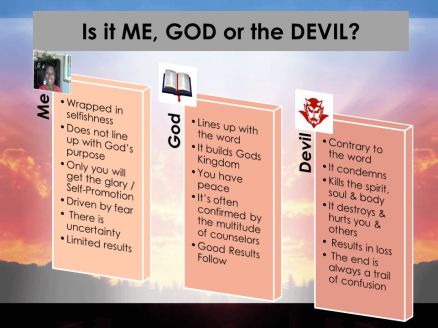
God’s voice, the evil one’s voice, and our own foolish folly. We must become familiar with the Word of God by reading the Bible, and studying the scriptures. Samuel, could not identify the Lords voice the first three times he called him, and Eli told him it was the Lord that had been calling him. He began to recognize the Lords voice over time. The same is true today, we must learn the Lords’s voice through trial and error until it becomes a norm.
In 1 Samuel 10:3,1-10, we see Samuel, a young bondservant of Eli’s, learning to identify God’s voice. The chapter is about Samuel’s conditioning. One night everyone was asleep, and Samuel thought he heard Eli calling. He went to him, and Eli was asleep. Samuel asked Eli, did you call master? Eli said, no. This happened two more times, each time Eli said, go back to sleep, I did not call you. The Lord called Samuel’s name a third time, again Eli told him to go back to bed, but before he left, Eli said, if He calls again, answer ‘Speak Lord, for Your servant hears.’
“Go, lie down; and it shall be, if He calls you, that you must say, ‘Speak, Lord, for Your servant hears.’” So Samuel went and lay down in his place. Now the Lord came and stood and called as at other times, “Samuel! Samuel!” And Samuel answered, “Speak, for Your servant hears.”
1 Samuel 3:8-10, NIV
When God first spoke to Samuel he did not know His voice, he learned to recognize his voice just as the sheep learn to recognize the sheepherders’ voice. Samuel learned to recognize Gods’ voice, and we must learn to do the same.
Both the Old and New Testament informs us that our Lord wants to have a relationship with us and to do so, we must learn to hear His voice. This is not as easy as it sounds, it is a process.  At times we hear the evil one mimicking the Lord’s voice nudging us to do or say something that is not consistent with the Word of God, and sometimes we follow the flock that does not belong to the Lord.
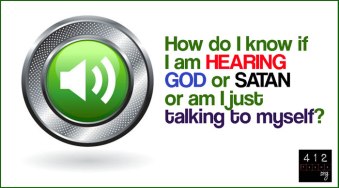
So, the question becomes, how do we know it is Gods’ voice? We know his voice because God will never tell or suggest anything that is not consistent with His Word. This means that when you hear the quiet voice if it is not the Word of God, it is not His voice. If the voice says, call in sick and go with your friends (lying); take the change off the counter, no one will see you (stealing); look at your friends test and copy their answers (cheating); refusing to help a co-worker (lack of gentleness); lying (dishonesty); and gossiping (lack of self-control).* it is the evil one’s voice you are hearing. His commands or suggestions never impart the  Fruit of the Spirit or Gods’ laws. We have to learn to identify which voice we are hearing. It is not exactly black or white, there is a third voice, our own, which sends us down a pathway fit for fools. You may ask, how do we avoid the pitfalls? The answer is, we learn His voice by reading the Bible, studying scriptures, researching commentaries, going to Bible Study and discussing the Word with others more mature in how to apply the Word of God in their lives. This is a lifelong process, but like Olympians, we may fall, stumble or fail, but we get back up and correct our weaknesses.
Changing our Filter
 Each week or month, recap your experiences that you have written down. How often did you identify the quiet voice as the evil one, how often was it the folly of your own making, and how often was it the quiet voice of God. Applying this process provides you the tools to manage your behavior while eliminating negative behavior. This process is similar to the steps Harm Reduction uses where you identify the attributes you want to maintain as those you want to eliminate.
As you are assessing whose voice you are hearing and following, you will begin to quickly acknowledge whose voice it is. If it’s the Lord, you will follow him, if it is another voice you will reject it and move on. And, as you read scriptures in the Bible, you will more readily begin to understand how the Word applies to our daily activities and become stronger Christian Warriors.
Changing the filter gives you the power to eliminate the toxins that make you ill, weak and subject to the wiles of the evil one. We learn to say and do what is right, not because people are watching, but because we are Gods’ children. We learn to be obedient and not act in a way that is comfortable to the flesh; as the Bible says, ‘not as men-pleasers but as bondservants of Christ, doing the will of God from our heart’. (Eph 6:5,6)
The voice we follow directs our path. Our goal is to become active in the Word, act obediently, and ultimately become wholly dependent on the Word of God. As we regularly change our filter, we will find fewer toxins existing in our lives. God’s voice will be acknowledged earlier and we will become more dependent upon his love for us. Our relationship blossoms and we become radical Christian Warriors.
######
Note, I mentioned in yesterdays Post that God often speaks to us three times to get our attention, this is another case of speaking three times before Samuel identifies his Voice and acknowledges the Lord.
Images-Google Images
Scriptures-Bible.com; Bible Studytools.com
* Learning to Recognize the Shepherd’s Voice. Carol Pipes. ww.christianitytoday.com. 2/21/2018
See my Post, From Punishment to Correction and Healing for more about the Fruit of the Spirit.
If you like what you are reading, follow me and receive the daily inspiration in your inbox

 with every believing soul-is the only basis on which the command to Joshua, thrice repeated, can wisely or securely be rested. It is mockery to say to a man conscious of weakness, and knowing that there are evils which must surely come, and evils which may possibly come, against which he is powerless, ‘Don’t be afraid’
  unless you can
 Genesis 18:1-15 is one such instance when he, to use a colloquialism of the day, ‘called someone out,’ no doubt tickled and laughing. It takes place in the Story of the Three Visitors. Three Visitors visited Abraham. One says to Abraham, Sarah will have a son by next year this time. [If she was of child-bearing age, it would be believable, but she is not, Sarah was I her 90’s.] The hilarious part begins in verse nine.

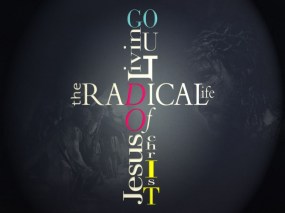 To unpack this, we are talking about radical change. You may ask, how does this relate to Consecration or Lent? Keeping in mind that no one can tell you what to pray about, this is a suggestion – If you plan to take part in this time of introspection, you may consider entering into prayer to discuss your radical change in becoming an active Christian Warrior with God.



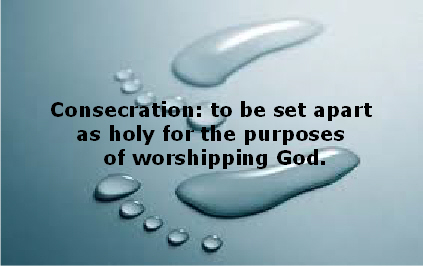 Consecration is not so much a ceremonial time as it is a commitment, a time of inspiration and gratitude. Lent is more sacrificial, in that Catholics and some Protestant denominations use this time to attain God’s blessing, which is antithetical because the New Testament teaches that grace cannot be earned, grace is the gift of righteousness.
 In essence, we give up our own claims on ourselves and put ourselves in Gods hands.







 . He reconciled our relationship with Him by sacrificing His son, Jesus Christ, who bore our sins at Calvary.
 When we fail to follow them, we suffer the consequences. Here are some examples: We decide that cutting corners at work will increase the profit margin; we fail to be honest and trustworthy. We cheat on a test in school; we are not honest or trustworthy. We mistreat loved ones, constantly bringing up their faults and disrespecting them, we are not showing love or kindness. You see someone in need, and you rush past them trying not to look them in the eyes, you are not showing affection, love or kindness to others. You are fraught with anxiety and worry when everything is falling apart; you are not demonstrating peace. You want everything today and rush through life; you are not patient; another word for patience is forbearance. Your speech is colored with cussing, and gossip is part of your conversations, you do not walk in integrity. When you are hard and legalistic, you are not demonstrating meekness or being gentle. You are not disciplined, you succumb to bad habits, large and small, deadly and barely perceptible, you lack self-control.
 or feel that something is not right when you are getting ready to say or do something out of character? When we sin, we suffer. When we suffer, we should examine our motives and actions and compare them to the Fruit of the Spirit and determine how we sinned, which is part of the process of correction. It is not God’s intent to punish us. God’s intent is to allow us to learn and correct our actions and through this process, it is His intent to allow us to heal.
 Lisa’s Daily Inspirations