We were called before the universe was spoken into being. We were created by God and called to be His people. Our calling is a Holy Calling.
~ Lisa Blair
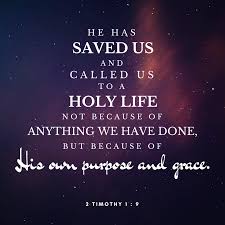
“who had saved us and called us with a holy calling, not according to our works, but according to His own purpose and grace which was given to us in Christ Jesus before time began,” II Timothy 1:9 NKJV
That is right, we have been called with a Holy calling, one that was made before the beginning of time. God envisioned this world and all in it before He created time before He created the universe. As children, many of us wrote stories about cosmos and its inhabitants, envisioning them to manifest our reality. We were enthralled by our own imaginations, but think, God created all that exists from His thoughts and being God, brought it in into being. Every minute detail manifested to become atoms, that became trees, land, water, nature, us. And, in doing so, He called us, giving us life and a desire to know Him better through His grace. To redeem us from the sin that destroyed Eden and His relationship with Adam and Eve who sinned against Him and stripped us, leaving us in a state of sin. We were called through His purpose to share that God sent His Son, Christ Jesus to save us from our sin nature and spread the Good News of our salvation. It is His gift of grace, not of our own doing.
GOD’S GIFT OF GRACE THROUGH THE DEATH OF HIS SON, CHRIST JESUS
“The LORD is my shepherd; I shall not want.” Psalms 23:1 NKJV
God has blessed me with long life. I’m 67 today and counting. There is no better life in that I have a wonderful husband, three healthy sons, their spouses and significant others, and two Granddaughters. Working out at the gym right now, took a break to share, ‘our God is a good God’. Praise the Lord, I am grateful.
“You shall walk in all the way which the LORD your God has commanded you, that you may live and that it may be well with you, and that you may prolong your days in the land which you will possess.
I know we all walk down the path into our destiny, the life God designed for us. We are not perfect but under construction; and for those of us with children have made mistakes while maturing as Christians. I’ve learned not to underestimate or doubt God’s purpose and GPS corrections. He welcomes all who seek Him. He is a God second chances and more. He knows our hearts.
Our children also walk with Him, make detours, but return to Him in due season.
6 Train up a child in the way he should go, [a]And when he is old he will not depart from it. Proverbs 22:6 NKJV
Continue in the Lord, He is with you and covers you, and your children as they grow into adulthood and old age.
For many years I felt the Lord was a punishing God. Words such as sorrow suggested that we were a hurt people. The truth is we are a hurt people, we are a sinful people who must come to a place where our sins are no longer acceptable as our guiding truth. Satan uses sin to capture and control us, to lead us to a hellish death. When we become remorseful and recognize the sorrow we have weighed down upon ourselves, and the God who loves and protects us, we enter into a state of Godly sorrow.
Godly Sorrow is only Mentioned Once in the Bible
Godly sorrow is only mentioned once in the Bible, in 2 Corinthians 7:10-11. Paul uses this term to explain to the Corinthians that they once lived a sinful life that would lead to worldly death, hell, upon departing this earth but had successfully turned away in earnestness to overcome their sin and repent.
Godly Sorrow is an Acute Sense of Sadness
Godly sorrow is an acute sense of sadness we experience when we sin. We feel sadness because we know we have committed sins. We know we have saddened the Lord, just as the Corinthians knew after Paul taught them that God is the Way and the Light. Palm chastised the Corinthians for their dissentions against the church. He intended to cause them to think and having accomplished this task caused them to repent. Paul knew they were remorseful and regretful for their actions of falling back into disbelief, but he also knew that neither would lead to salvation without true repentance and restitution. Godly sorrow brings repentance that leads to salvation.
Godly Sorrow is a Kind of Wretchedness
“Godly sorrow is a kind of wretchedness that can bring the repentant sinner to tears of grief. Godly sorrow results from a heartfelt conviction that we have offended God by our sin.” Our spirit grieves, and when Godly sorrow has its way, we resolve to stop repeating the sins, turn away from our carnal nature and pick up the cross and do good. We cleanse ourselves through prayer.
Results of Godly Sorrow
Doing good, is the result of Godly sorrow. It is through Godly sorrow that we can release the guilt and shame for our sin nature and actions, and repent asking for forgiveness and vowing to never return to them. Repentance is not an emotion, it is our decision to change. We have to make the decision to turn around and change our lives to truly repent. We repent and believe through faith. Faith comes after repenting and surrendering our life to the Lord. It is through God’s grace that we are forgiven and given new life to move forward. It is through God’s grace that we receive salvation.
God Sorrow, Repentance, and Salvation are Ours
Not all of 1 Corinthians 7 is intended for us. Some of it is intended for the Corinthians. However, repentance and salvation are for everyone who calls out to God to save them from their sins and believes that Christ died on the cross and rose from the dead to join God in heaven. God restored the discipline of the church of Corinth and sin, and He restores us. We sin through our (own) actions and complicitous approval of those sinning in our scope of influence. The church was complicit by not addressing incestuous behavior. We are complicit when we do not speak out against sin and do not address the offender.
Sorrow Cannot Merely Be Guilt through Discovery
“We must be very careful that our sorrow for sin is not merely sorrow that has been found out, but sorrow which, seeing the evil of the sinful thing is determined never to do it again and has dedicated the rest of its life to atone, by God’s grace, for what was done.” (Barclay)
Godly Sorrow, Apology and the Holy Spirit, Intercession on Our Behalf
When we pray, the Holy Spirit intercedes and helps us apologize to God and repent. This is accomplished through confessing our sins, not by denying them or defending them because neither is true confession.
Godly Sorrow is the Lining of Our Repentance
While Godly sorrow is only mentioned once in scripture, it is the lining of our repentance. Repentance separates godly sorrow from worldly sorrow. Godly sorrow produces true repentance. Worldly sorrow is not really sorrow, it is the only resentment that has been found out (William Barclay). If we do not feel Godly sorrow for our sinful actions, we are not able to truly repent and turn away from them with God’s help. Without godly sorrow, we would repeat the offense, given a chance to do it again. Godly sorrow not only hates the act, but it also hates the nature of the act itself. Without godly sorrow, we are bound by our sin nature and remain in the camp of the evil one.
God Separates Us From Our Sin Through Our Decision to Change
Knowing Jesus.com
Like the Church at Corinth, we are growing (maturing) when we repent and turn away from sin. God can separate us from our sins and place them as far away as the east is from the west, but He is only able to do so when we are cleansed and convicted to the point of wholehearted confession and repentance. It is through God’s grace that we are saved.
Images – YouVersion/Bible.com; Google Images-Knowing Jesus.com
References – What is Godly sorrow? Gotquestions.org; Studylight.org: 2 Corinthians 7:10-11, Commentaries – Charles Barclay, Albert Barnes, Coffman, John Gill; Nelson’s Quick Reference by Warren Wiersbe; Vine’s Complete Expository Dictionary by W.E. Vine; KJV Word Study; Youtube:2Corinthians_BrettVarner; 2 Corinthians_JasonJack
Jesus is no pioneer. He is not a colonizer or an explorer. He is the Son of God and a member of the Trinity.
~ Lisa Blair
The NIV version of the Bible refers to Christ as a pioneer. I like the term ‘pioneer’. It stands out to me. But, it is not accurate – as a noun it means, a person who is among the first to explore or settle in a new place. He was not a colonizer, trailblazer, or explorer. Jesus was not among the first. He was the first and only Son of God.
As a verb, it is still left wanting. I would not call Him an innovator or developer. He did not launch a new project. He brought us a new way of life. The King James Version reports, God is the Author and finisher of our faith.
In Him, all things are possible for those who accept Him as our Lord and Savior (Matthew 19:26). We can do all things through Christ who strengthens us (Philippians 4:13). We believe and have faith. We cannot fear or be dismayed because we are new creatures in Christ. He resides in us (Holy Spirit), and around us. He protects us and gives us (eternal) life. He upholds us with the right hand of His righteousness (Isaiah 41:10). There is no other like Him.
The King James Version carries the weight of who Christ is to those of who love Him. All other versions fail.
Jesus humbled himself to the point of death to give us life. We should be able and willing to humble ourselves and, honestly, repent for our sins (stating what they are or were) and start anew (fresh). It is never too late, God forgives us when we repent, allowing us to move-on shackle free. Christ gave us the opportunity to rise above who we (presently) are. It is time to change our home location, we are in this world, but not of this world.
Go to a quiet place and speak to God, ask Him to forgive you. You choose the place. It could be in the midst of a train station, bar, standing on the corner in busy traffic. Just still yourself and pray. He will receive you wherever you are at the moment.
God so loved the world, He gave us His only son to save us and give us direction. The most important commandment is to love one another.
~ Lisa Blair
Photo: L. Durden
God does not discriminate. He wants everyone to believe and receive Salvation.
Jesus’ Travels
Some time ago I wrote a post stating that Christ traveled outside of the Holy Lands to spread the Good News which was incorrect. In fact, I took it down. Looking back, I did not mean to write Jesus traveled to other parts of the world, I meant His influence spread across the regions.
Jerusalem was considered the capital City and was a commerce hub during Christ’s life. It was one of the major economic, administrative, spiritual, and cultural centers of the land. Merchants throughout the Middle-east, Arabia, India, and Egypt traveled there on land and across the Persian Gulf. Foreign markets connected the trade routes from Israel through Northern Africa, India, Malaysia, and the Arabian peninsula. (Footsteps of Abraham, by Malachi Martin. NT Times.com, archives. March 13, 1983)
The Disciples traveled through the Middle East Spreading the Good News
Jesus did not travel the world to reach nonbelievers and those following other religious faiths. Knowledge of the Messiah was spread by the disciples, others, and from people who lived in other countries and traveled the trade routes. I think it is safe to say that the Word was carried in part by merchants who learned of Christianity when visiting Jerusalem and other cities/towns Jesus ministered in. They were most likely unintentionally seeding hearts. The Word was spread in many ways.
After Jesus’ death, the disciples traveled throughout the regions as well, see above map, and therefore had many opportunities to preach to Gentiles from various religious backgrounds. Jesus commanded the disciples to spread the Good News bear and far. He assigned us, Christians, to do the same and to spread the Good News, God’s Truth, wherever we are. To this end, we should not be so insular as to communicate God’s message with only other Christians. We must suck it that the Gentiles are anyone that is not Jewish, they are people from all backgrounds and faiths who God claims through adoption. God does not discriminate nor should we.
Map of Middle Eastern Old Testament. Taxomita.com
Images/Maps – Romans 1:16, L.Durden; The Travels of Our Saviour. Pinterest.com; How the World looked when Jesus was born, according to Roman Geographers. by Sarah Laskow. atlasobscura.com; Map of Middle Eastern Old Testament. Taxomita.com
Resources – Footsteps of Abraham, by Malachi Martin. NT Times.com, archives. March 13, 1983; Commerce and the Temple in First Century Jerusalem by David Hendin. Bibleodyssey.org; Teachingthem.com;



 Lisa’s Daily Inspirations